
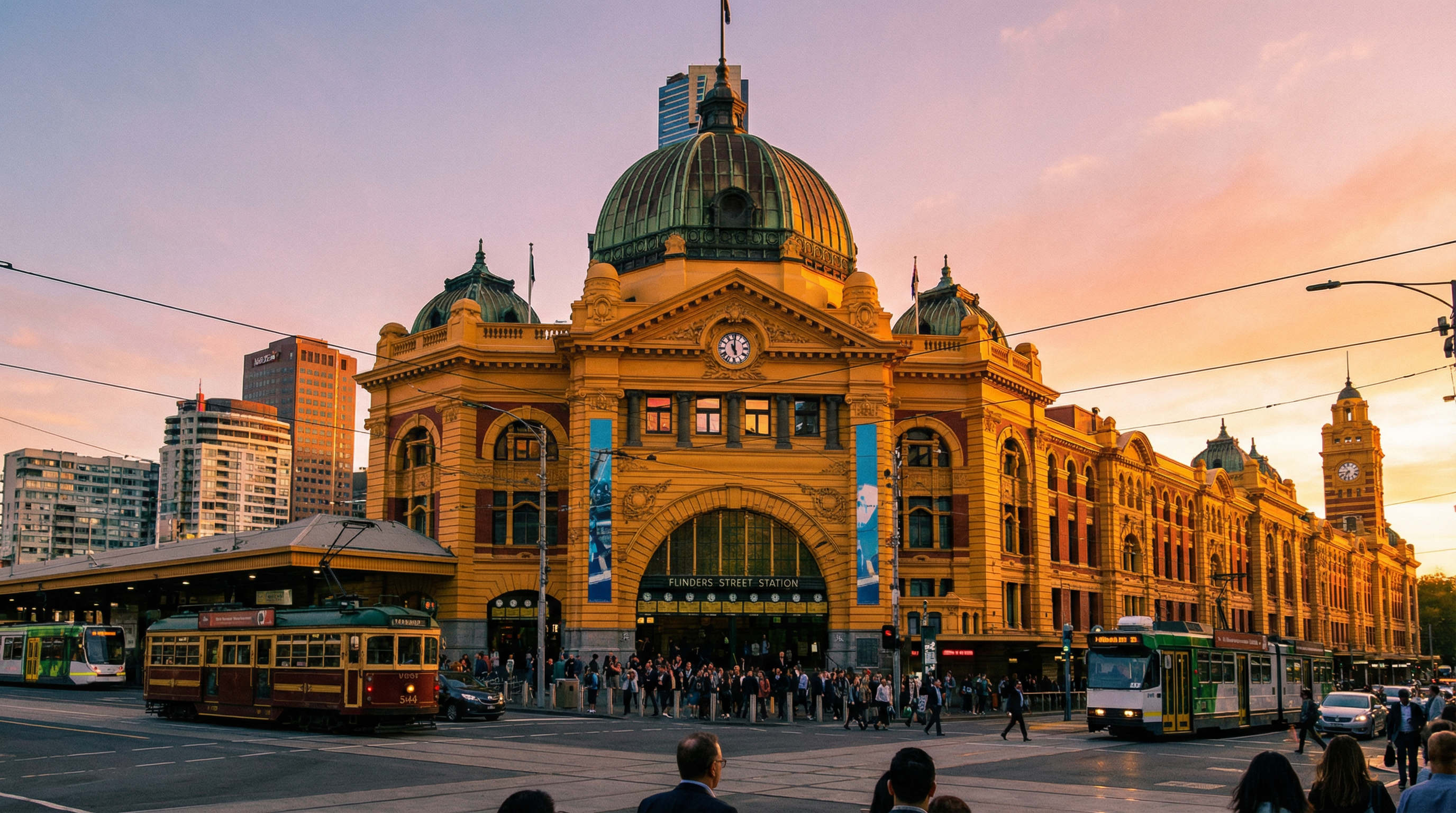
Fitzroy’s location — roughly 2 kilometres northeast of Melbourne CBD — makes it one of the best-connected inner suburbs for commuting. The trade-off is that Fitzroy has no train station, which means commuters rely on trams, buses, cycling, or walking. For most residents, this is not a problem. For those who need to reach destinations beyond the CBD, it requires a bit more planning.
Commute Times to Melbourne CBD
The headline number is straightforward: getting from Fitzroy to the CBD takes between 10 and 25 minutes depending on your mode of transport and exact starting point.
| Mode | Typical Time to CBD | Peak Hour Adjustment | Cost |
|---|---|---|---|
| Cycling | 10–15 minutes | Minimal impact | Free |
| Tram (Route 11 or 86) | 15–20 minutes | Add 5–10 minutes | myki fare |
| Walking | 25–35 minutes | No impact | Free |
| Driving | 10–15 minutes (off-peak) | 20–30 minutes (peak) | Parking $20–$40/day |
| Bus (Route 200/207) | 15–25 minutes | Add 5–10 minutes | myki fare |
Tram Network
Fitzroy is served by three tram routes that provide direct access to the CBD and surrounding suburbs.
Route 11 runs along Brunswick Street — Fitzroy’s main commercial strip — connecting West Preston in the north to Docklands in the south via the CBD. This is the most-used route for Fitzroy commuters heading to the city. During peak hours, trams run every 5–8 minutes. The journey from Brunswick Street/Johnston Street to Flinders Street takes approximately 15 minutes in normal conditions, though peak-hour congestion on Nicholson Street can add time.
Route 86 runs along Smith Street and Gertrude Street, connecting Bundoora in the north to Docklands via the CBD. This route is useful for commuters on the eastern side of Fitzroy and provides an alternative when Route 11 is delayed.
Route 96 runs along Nicholson Street on Fitzroy’s western boundary, connecting East Brunswick to St Kilda Beach via the CBD. This is Melbourne’s busiest tram route and one of the longest — it connects Fitzroy residents to South Melbourne, Albert Park, and St Kilda without changing.
All three routes operate within the Free Tram Zone once they enter the CBD, meaning the last few stops of your journey are free if you are travelling into the city.
Cycling
Fitzroy is consistently ranked among Melbourne’s most cycleable suburbs, and for good reason. The flat terrain, grid street layout, and proximity to the CBD make cycling the fastest and most reliable commute option for most residents.
The key cycling routes from Fitzroy to the CBD include the Capital City Trail (accessible via Edinburgh Gardens), which provides a largely off-road route into the city along the Yarra River. The Canning Street bike lane connects Fitzroy to Carlton and the University of Melbourne precinct. Nicholson Street has a dedicated bike lane running south into the CBD.
Bike commute times from central Fitzroy to key CBD destinations are consistently under 15 minutes — often faster than the tram during peak hours. The City of Yarra has invested in protected bike lanes on several key routes, and the rollout continues through 2026.
Secure bike parking is available at major destinations, though theft remains a concern. Always use a quality U-lock and avoid leaving bikes locked on the street overnight.
Driving and Parking
Driving from Fitzroy to the CBD is fast off-peak (10–15 minutes via Nicholson Street or Smith Street) but significantly slower during morning and evening peaks. The Eastern Freeway is accessible via Alexandra Parade for commuters heading to eastern suburbs like Box Hill, Ringwood, and the Yarra Valley.
Parking in Fitzroy itself is predominantly street parking with time restrictions. Most residential streets require a City of Yarra parking permit ($50–$100 per year for residents). Visitor parking is time-limited (typically 1–2 hours) on commercial streets and unrestricted on some residential streets further from Brunswick and Smith Streets.
For CBD-bound drivers, parking costs $20–$40 per day in commercial car parks. Most Fitzroy commuters who work in the CBD find that tram or cycling is both faster and cheaper than driving.
Commuting Beyond the CBD
For commuters whose workplaces are outside the CBD, Fitzroy’s lack of a train station becomes more relevant. The nearest train stations are:
| Station | Distance from Central Fitzroy | Lines Served |
|---|---|---|
| Collingwood | 1.2 km (walk or short tram) | Hurstbridge, Mernda |
| North Richmond | 1.5 km | Hurstbridge, Mernda |
| Parliament | 1.8 km (via tram) | All lines except Stony Point |
| Clifton Hill | 1.5 km | Hurstbridge, Mernda, South Morang |
For commuters heading to eastern suburbs (Hawthorn, Camberwell, Box Hill), the Collingwood or Clifton Hill stations provide access to the Hurstbridge and Mernda lines, with interchange at Richmond for the Lilydale/Belgrave lines.
For commuters heading to western suburbs (Footscray, Sunshine, Werribee), the most practical route is tram to the CBD then train from Southern Cross or Flinders Street.
For commuters heading to southeastern suburbs (Caulfield, Dandenong, Frankston), tram to Flinders Street then train on the relevant line is the standard route.
Work From Home Impact
Fitzroy’s commute picture has shifted since the pandemic normalised hybrid work. Many residents now commute to the CBD only 2–3 days per week, which has reduced peak-hour pressure on tram routes and made parking slightly easier on non-commute days. The suburb’s excellent cafe and coworking scene means that working from the suburb — rather than from home — is a genuine option for remote workers.
Last updated: April 2026. Travel times based on PTV timetables and Google Maps real-time data.
💬 Discussion
Join the conversation — no account needed