1. Verdict Box
Richmond in 2026 is the inner-suburb whose price floor is structurally supported by a piece of infrastructure no other inner-east suburb has — the MCG / sports-precinct corridor. The walking-distance-to-MCG premium is real and durable, and it’s the single feature that most distinguishes the Richmond forecast from Collingwood, Fitzroy and Brunswick.
The modelled houses median lands at $1.32M end-2026 with a 13% three-year growth case. That’s slightly below Fitzroy and Brunswick on the forecast curve, but more defensible on the downside because the sports-precinct demand floor doesn’t move. The swing risk is Victoria Street and Burnley Street apartment supply, where the inner-east pipeline still has substantial unbuilt stock.
For live pricing read Richmond median prices.
2. At-a-Glance Table
| Timeframe | Modelled houses growth | Projected median (houses) | Confidence |
|---|---|---|---|
| End 2026 (remaining) | +3% | $1,320,000 | Moderate-High |
| End 2027 | +8% | $1,370,000 | Moderate |
| End 2028 | +10% | $1,408,000 | Moderate |
| End 2029 (3-yr cumulative) | +13% | $1,491,000 | Moderate |
| 10-yr historical CAGR | ~7.6% p.a. | — | High |
| Apartments median (now) | ~$540-600K | — | Moderate |
3. Who It Suits
Sports-precinct / CBD commuters — the natural Richmond cohort. Households who want sub-15-minute travel to MCG, the SCG-equivalent stadium economy, and Flinders Street station, with a heritage cottage in the bargain.
Owner-occupier upgraders from East Melbourne or South Yarra — Richmond is the relative-value play for buyers who otherwise can’t justify South Yarra or East Melbourne’s $1.6M+ floor. Heritage Victorian cottages on Bridge Road’s residential side compound at the suburb-wide rate.
Investors with a balanced thesis — Richmond is one of the few inner-east suburbs where the rental story (proximity to St Vincent’s, Epworth and the sports precinct, plus strong student demand) is structurally deep enough that the investor case isn’t pure capital growth. See our Richmond investment guide for the asset-by-asset breakdown.
Apartment buyers — proceed selectively. Heritage walk-ups along Bridge Road outperform Victoria Street / Burnley Street new-builds materially on resale. Our Richmond honest guide covers the pocket-by-pocket reality.
4. Rent & Property Reality
Richmond two-bedroom heritage cottages currently sit around $1.28-1.35M; three-bedroom terraces $1.45-1.75M; new-build apartments along Victoria Street $570-720K. Rents are firm — two-bed houses around $780-870/week, one-bed apartments $480-550/week. For the live rental position see the Melbourne rent prices all suburbs 2026 reference and Prahran rent report for comparable inner-east context.
What this actually means: Richmond’s gross house yield runs ~3.6%, broadly in line with Fitzroy and Brunswick. Apartment yield is ~4.5-5.0% gross. The MCG-walking-distance feature gives Richmond a structural floor that the other inner-north / inner-east suburbs simply don’t have — events economy, hospitality clusters around Swan Street, and a 7-day demand cycle.
5. Local Reality & Pockets
Bridge Road residential streets — the median-anchor pocket. Two-to-three bedroom heritage cottages on the streets running parallel and perpendicular to Bridge Road. These streets compound at or above the modelled 13% three-year figure.
Swan Street / sports-precinct pocket — closest to the MCG. The houses here carry the highest walk-to-stadium premium in inner Melbourne. Limited supply, strong owner-occupier demand. Pair with our Richmond cost of living for the full living-cost picture.
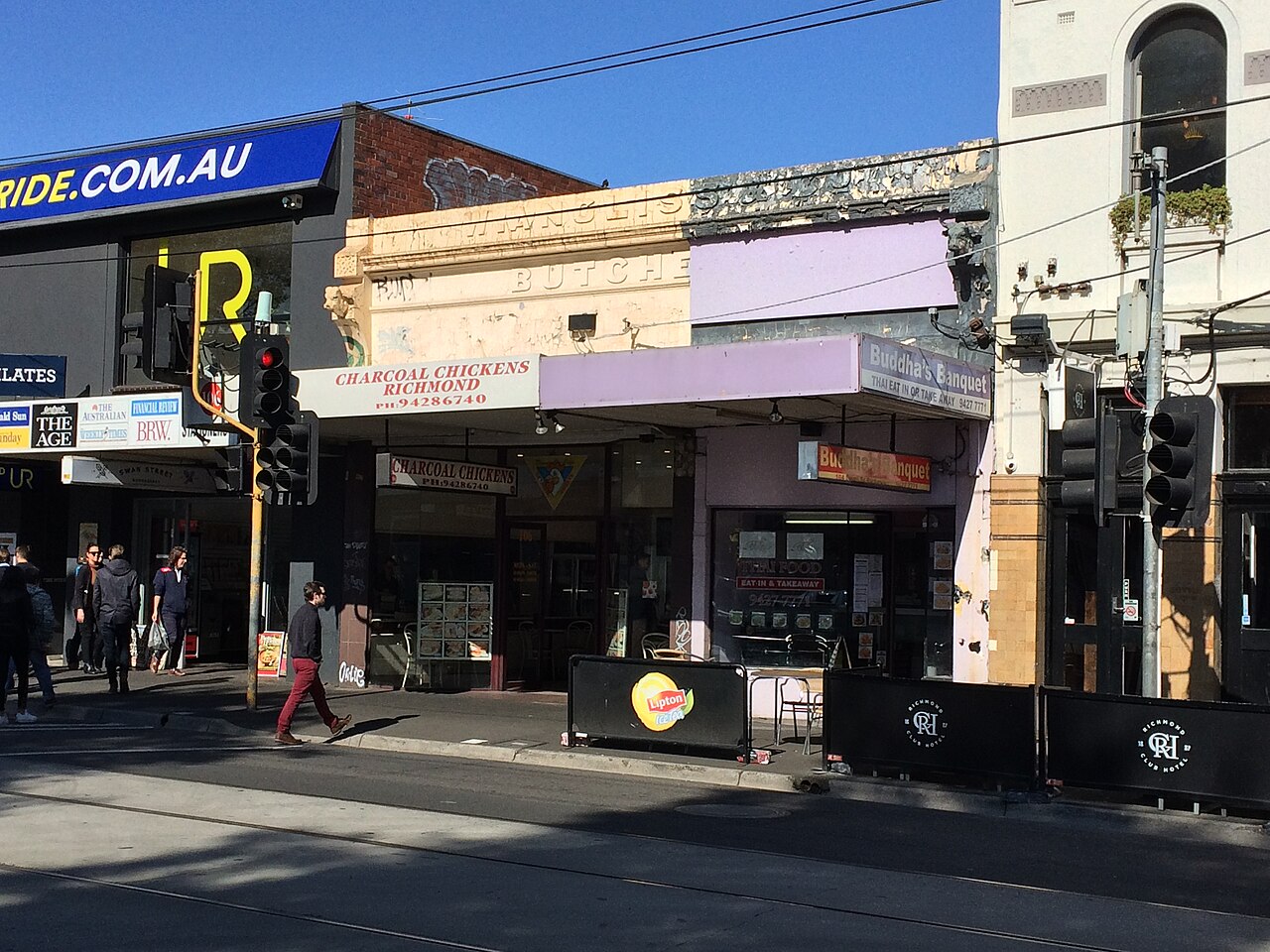
Victoria Street strip — the Vietnamese-Australian commercial corridor, apartment-heavy, the supply-vulnerable pocket. Strong tenancy demand from St Vincent’s / Epworth nurses, students, and hospitality workers. Capital growth lags the residential streets.
Burnley fringe (east) — relative-value pocket, weaker on amenity, stronger on land size. Returns to our Richmond best takeaway and Richmond cheap eats for the food-economy texture.
6. Signature Craving
Pellegrini’s-style continental cafes along Swan Street plus the Vietnamese pho cluster on Victoria Street are the cultural-economy props that justify the Richmond residential premium. The walking-distance-to-MCG feature is structural infrastructure; the Swan Street / Victoria Street commercial economy is what makes those streets liveable when there isn’t a game on.
For best meals across the suburb, our best Asian food in Richmond and Richmond budget breakdown guides tie the food economy to the residential decision.
7. Comparisons Table
| Suburb | Modelled 3-yr growth (2026-2029) | Houses median now | Yield (gross) | Demand-floor strength |
|---|---|---|---|---|
| Richmond | ~13% | ~$1.32M | ~3.6% | High (MCG precinct) |
| Fitzroy | ~17% | ~$1.18M | ~3.6% | Moderate-High |
| Collingwood | ~16% | ~$865K | ~4.3% | Moderate |
| Brunswick | ~14% | ~$1.30M | ~3.5% | Moderate |
| Carlton | ~12% | ~$1.45M | ~3.4% | High (institutional) |
| South Yarra | ~12% | ~$1.65M | ~3.2% | High |
Forecast columns are scenario models; treat the rank order as more reliable than the precise percentages.
8. Trust Block
Author: Sophie Chen — financial journalist with a decade of property-market coverage, focused on inner-east Melbourne and modelled growth scenarios.
Sources:
- CoreLogic suburb-level price indices and growth models, Richmond postcode 3121.
- Victorian Planning Authority Victoria Street / Burnley Street planning, 2025-2026.
- ABS population and dwelling projections, Census 2021 base.
- Domain and realestate.com.au listings observation, Richmond postcode, 2026.
Disclosure: This is a property-market forecast, not financial advice. Past growth does not guarantee future performance. Forecasts are scenario models — interest-rate moves, apartment-supply pipelines and major-event scheduling at the MCG / sports-precinct are the variables that move Richmond.
9. FAQ
Q: What’s the 2026 forecast median house price in Richmond? The modelled houses median lands around $1,320,000 at end-2026, up roughly 3% from early-2026.
Q: What about 2027, 2028, 2029? Modelled growth runs +8% to end-2027 ($1.37M), +10% to end-2028 ($1.41M), and +13% three-year cumulative to end-2029 ($1.49M). Confidence is moderate.
Q: What makes Richmond different from Collingwood or Fitzroy? The MCG / sports-precinct demand floor. Richmond is the only inner-Melbourne suburb where a permanent piece of infrastructure draws walking-distance commercial demand seven days a week, ten months a year.
Q: Are apartments a good buy in Richmond? Selectively. Heritage walk-ups along Bridge Road: yes. New-build Victoria Street / Burnley Street stock: cautious — apartment-supply risk is real.
Q: What’s the gross rental yield on a Richmond house? Around 3.6% gross, ~4.5-5.0% on apartments. Net yields after costs are well under the gross headlines.
Q: What’s the biggest risk to the forecast? Apartment oversupply along Victoria Street / Burnley Street, interest-rate rises (suppresses growth 2-4%), and any structural change to MCG / sports-precinct events scheduling.
Q: How does Richmond compare to South Yarra and Prahran? Richmond is cheaper on entry price than South Yarra, broadly comparable to Prahran. The MCG premium is unique to Richmond; South Yarra’s premium is shopping / restaurant infrastructure.
Q: When is the next review of this forecast? October 2026 — when CoreLogic Q3 data, RBA rate cycle and apartment-supply pipeline updates feed back into the model.
For inner-east and inner-south comparables, see Prahran rent report, South Melbourne rent report and Melbourne CBD rent report. For Richmond’s day-to-day food and lifestyle texture, the Richmond best Asian food round-up ties forecast to the cohort that supports the demand floor.


