Melbourne Transport Guide 2026: Trains, Trams, and Getting Around
Updated 16 March 2026 | Sam Torres reporting
Melbourne’s transport network is sprawling, occasionally unreliable, and genuinely one of the best public transport systems in the Southern Hemisphere — if you know how to use it. Whether you’ve just moved here, you’re visiting, or you’ve lived here your whole life and still get confused by the train timetable at Richmond, this guide is for you.
I’m Sam Torres, MELBZ’s Transport Editor, and I catch public transport across Melbourne roughly 300 days a year. I’ve been delayed by signal faults at Flinders Street, packed into the 86 tram like a sardine on a Saturday night, and cycled across the West Gate Bridge in winds that nearly killed me. I know this network. Let me walk you through it.
The Myki Card — Your Ticket to Everything
Let’s start with the basics. The Myki card is Melbourne’s contactless transport ticket. You tap on and off trains, trams, buses, and some regional V/Line services. It costs $6 for a new card (available at 7-Eleven stores, staffed train stations, and via the PTV app), and you load money onto it as you go.
Myki fares in 2026:
- Zone 1 (CBD and inner suburbs): $5.30 daily cap
- Zone 1+2 (outer suburbs): $7.80 daily cap
- Zone 2 only: $5.30 daily cap
The daily cap means you’ll never pay more than the equivalent of a day pass. Once you hit that cap, the rest of the day’s travel is free. This is genuinely good value if you’re doing multiple trips.
Pro tip: Download the PTV app and add a digital Myki. It works on Android and, as of early 2026, is finally available on iPhone. No more fumbling for a plastic card in your bag while the tram driver gives you the death stare.
One thing that catches people out: the Free Tram Zone. Within the CBD and Docklands (roughly bounded by Queen Victoria Market, Spring Street, Flinders Street Station, and Docklands), trams are completely free. You don’t need to tap on. But the moment you cross that boundary, you’re in a paid zone — tap on, or risk a $287 fine from an authorised inspector. They’re not lenient.
🗳️ MELBZ POLL: How do you get to work?
- 🚂 Train — I live on a train line and I’m grateful
- 🚊 Tram — I’m a creature of habit (and Route 19 is my life)
- 🚲 Bike — I’ve accepted the risk
- 🚗 Car — the parking bill is killing me but I can’t quit it
- 🏠 WFH — I haven’t tapped a Myki since 2024
[Vote now — results updated weekly]
Melbourne’s Train Network
Melbourne’s train network is the backbone of outer-suburban commuting. Run by Metro Trains Melbourne, there are 16 lines radiating from the CBD, each terminating somewhere in the suburbs. The main CBD stations are Flinders Street, Southern Cross, Parliament, Melbourne Central, and Flagstaff — all on the City Loop.
Here’s a quick rundown of the lines you’ll actually use:
The essentials:
- Sandringham Line — Runs along the bay from the CBD to Sandringham. Beautiful coastal views on the back half. BRIGHTON BEACH and its bathing boxes are on this line.
- Frankston Line — The main line to the Mornington Peninsula. Gets packed on summer Fridays as everyone heads to the beach. The express services from Flinders Street to Frankston take about 55 minutes.
- Belgrave/Lilydale Lines — Your gateway to the Dandenong Ranges and the Puffing Billy steam train. The Belgrave terminus is leafy, hilly, and worth a weekend trip — check our Brunswick weekend guide for the full day-out plan.
- Glen Waverley Line — Straight to the food courts and Asian grocers of Glen Waverley. This suburb is one of Melbourne’s most underrated food destinations. If you haven’t eaten on Kingsway, sort your life out.
- Pakenham/Cranbourne Lines — The southeast corridor. Heavily used, recently upgraded with High Capacity Metro Trains that actually have decent air conditioning.
- Werribee/Williamstown Lines — The western suburbs. Werribee is having a proper moment right now with new housing and a growing food scene.
- Sunbury/Craigieburn/Upfield Lines — The northern suburbs. The Upfield line runs through Brunswick and Coburg — prime inner-north territory.
- Williamstown — Charming waterfront terminus worth a weekend visit.
Frequency: During peak, trains on major lines run every 5–10 minutes. Off-peak, expect every 15–20 minutes. Late night, it thins out to every 30–40 minutes, and the Night Network (Friday and Saturday nights) runs all-night trains on select lines.
Honest take: Metro’s reliability has improved significantly since the High Capacity Metro Trains rolled out on the Pakenham and Cranbourne lines. But delays still happen — especially on the Craigieburn and Upfield lines where the older trains are still running. Signal faults at Flingers Street are basically a Melbourne tradition at this point. Always leave a buffer for anything important.
Trams — The Icon
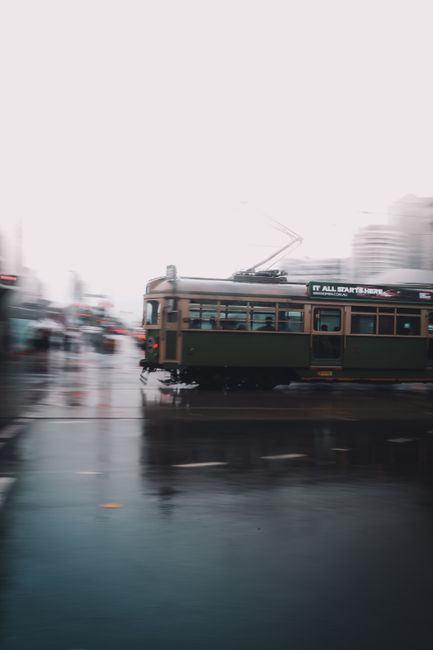
Melbourne has the largest urban tram network in the world. Over 250 kilometres of track, 24 routes, and roughly 1,700 tram stops. If you’re in the inner suburbs, there’s almost certainly a tram stop within a five-minute walk.
The routes you need to know:
- Route 96 — St Kilda to the CBD via Fitzroy and Carlton. Arguably Melbourne’s most iconic tram route. Runs through some of the best eating and drinking strips in the city. If you’re hitting Brunswick Street in Fitzroy, this is your tram.
- Route 86 — Docklands to Bundoora via the CBD, Bourke Street, Smith Street, and Preston. The nightlife strip of Smith Street between Johnston and Gertrude is one of Melbourne’s best — and the 86 gets you there.
- Route 19 — City to Craigieburn via Sydney Road, Brunswick. If you live in Brunswick, this tram is your lifeline and also your biggest frustration. It’s slow, crowded, and absolutely essential.
- Route 75 — City to Vermont South via Toorak Road and Camberwell. The eastern suburbs workhorse.
- Route 109 — Box Hill to Port Melbourne via the CBD. The 109 is long, reliable-ish, and connects two very different worlds — the suburban hustle of Box Hill to the bayside calm of Port Melbourne.
- Route 48 — City to North Balwyn via Bridge Road, Richmond and Kew. Bridge Road used to be Melbourne’s discount shopping strip — it’s pivoted to cafes and restaurants now, and the 48 trundles through the middle of it.
- Route 70 — City to Wattle Park via Church Street, Richmond. Church Street in Richmond is the street that Bridge Road wishes it still was — better food, less pretension, lower rents.
A word on trams at night: Trams are your best friend after dark. They’re well-lit, frequent in the inner suburbs, and free in the CBD zone. But past 11pm, frequency drops hard. If you’re out in Fitzroy or Collingwood and the next tram is 25 minutes away, an Uber is probably worth the $12–18.
Buses — The Underrated Option
Nobody talks about buses. Melbourne’s bus network is vast but underused, and honestly, the timetables can feel like they were designed by someone who’s never actually needed to catch one.
That said, if you’re in the north-western suburbs (Airport West, Taylors Lakes, Hillside), buses are sometimes your only public transport option. The SmartBus routes (like the 901 from Frankston to the airport via Dandenong) are genuinely useful for outer-suburban connections.
The SkyBus from Southern Cross to Melbourne Airport is the one bus everyone uses. It runs every 10–15 minutes, takes about 30 minutes, and costs $19.75 one way ($39.50 return). Not cheap, but faster and more reliable than the 901.
Cycling — For the Brave (and the Prepared)
Melbourne’s cycling infrastructure has improved a lot. There are now proper protected bike lanes on Swanston Street, La Trobe Street, St Kilda Road, and several inner-suburban routes. The Capital City Trail loops around the CBD via the Yarra River and is one of the nicest urban rides in Australia.
Key routes:
- Capital City Trail — Flat, scenic, mostly car-free. The loop from Flinders Street Station around through Docklands, along the Yarra to Abbotsford, and back through Fitzroy is about 25km and perfect for a weekend morning.
- Main Yarra Trail — Follows the river from the CBD out to Kew and beyond. Beautiful in autumn. terrifying in spring when the path floods.
- Merri Creek Trail — From the CBD north through Coburg and Fawkner. The inner section through North Fitzroy and Coburg is excellent.
- Corporate Trail — St Kilda to Brighton along the coast. Flat, breezy, and the bay views are worth the wind burn.
Bike share: Melbourne Bike Share (now operated as Lime e-bikes) has dockless e-bikes all over the inner suburbs. They’re handy for short trips but the pricing ($1 unlock + $0.38/min) adds up fast. A personal bike is cheaper in the long run if you ride regularly.
Safety note: Melbourne drivers are getting better at sharing the road with cyclists, but “better” is a low bar. Wear a helmet (it’s the law, and you’ll get a $227 fine if you don’t). Use lights at night. And be careful on St Kilda Road at the Flinders Street intersection — that junction is a death trap during peak hour.
🔧 THE MOVE: If you’re cycling for commuting, here’s the play
Get an e-bike if your commute is over 8km. Melbourne has enough hills (looking at you, Richmond to Kew climb) that you’ll arrive sweaty on a regular bike in summer. A decent e-bike like the Merida eSpresso or an Aventon will cost $1,500–$2,500 and pay for itself in saved Myki fares within 6 months if you’re commuting daily. Park it inside your office if possible — bike theft in the CBD is rampant.